Bali's Lakes and Hot Springs, and the Goddess Who Owns Them
July 27, 2026 · Miragi Team
Bali's lakes are not recreational features. They are the source of the irrigation water that every rice terrace on the island depends on, and they are understood to belong to Dewi Danu, goddess of the waters — which is why the most important lakes have temples on their shores and why water allocation has historically been settled at those temples rather than in an office.
Five sites, all in the cool highlands, all worth going out of your way for.
Danau Batur — Bangli
The big one: a caldera lake of 16.05 square kilometres, averaging 50.8 metres deep, sitting inside the Batur crater in Kintamani.
The legend explains the shape. Kebo Iwa, a giant, was digging a well to help villagers who had no water — and was trapped in it. The well became the lake. You can take a boat out, or do what most people do: sit at one of the ridge cafés above it with a coffee and the whole caldera laid out in front of you.
Danau Buyan — Buleleng
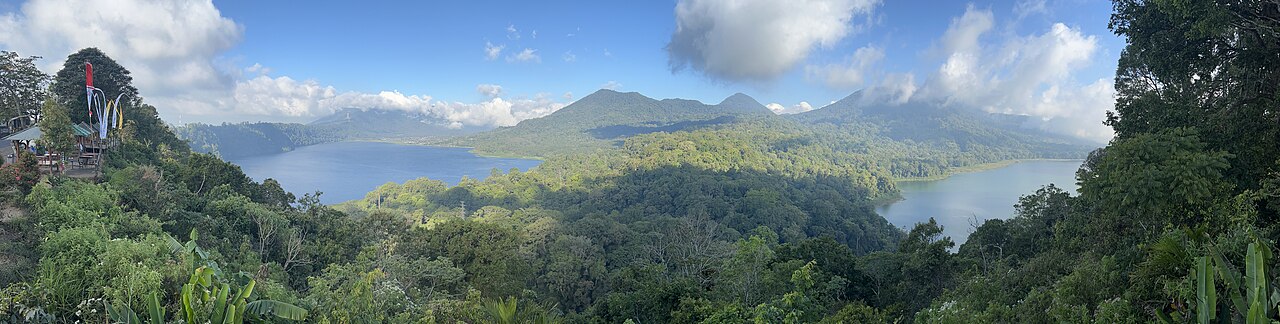
Photo: Stefan Fussan — CC BY-SA 3.0, via source

One of the three twin lakes in Bedugul, in Pancasari Village, ringed by untouched tropical rainforest.
The view that makes it is Mount Agung rising over a thin layer of mist. Boating, fishing, camping and cycling are all on offer. Legend says the three lakes formed from the tears of the gods — or of a powerful hermit, depending who's telling it — and that each is guarded by a lake queen who keeps its water pure.
Danau Tamblingan — Buleleng

Illustration: Miragi
Its neighbour, at 1,000 metres, backed by Mount Lesung and dense forest. Cool enough that you'll want a layer.
Tamblingan carries the heaviest spiritual weight of the three: thirteen temples stand around the lake, including Pura Ulun Danu Tamblingan, held to be where Dewi Danu resides. The lake is believed to heal, a tradition that traces to a plague cured with its water. Fishing and traditional boat trips only; this is not a jet-ski lake.
Batur Natural Hot Spring — Bangli
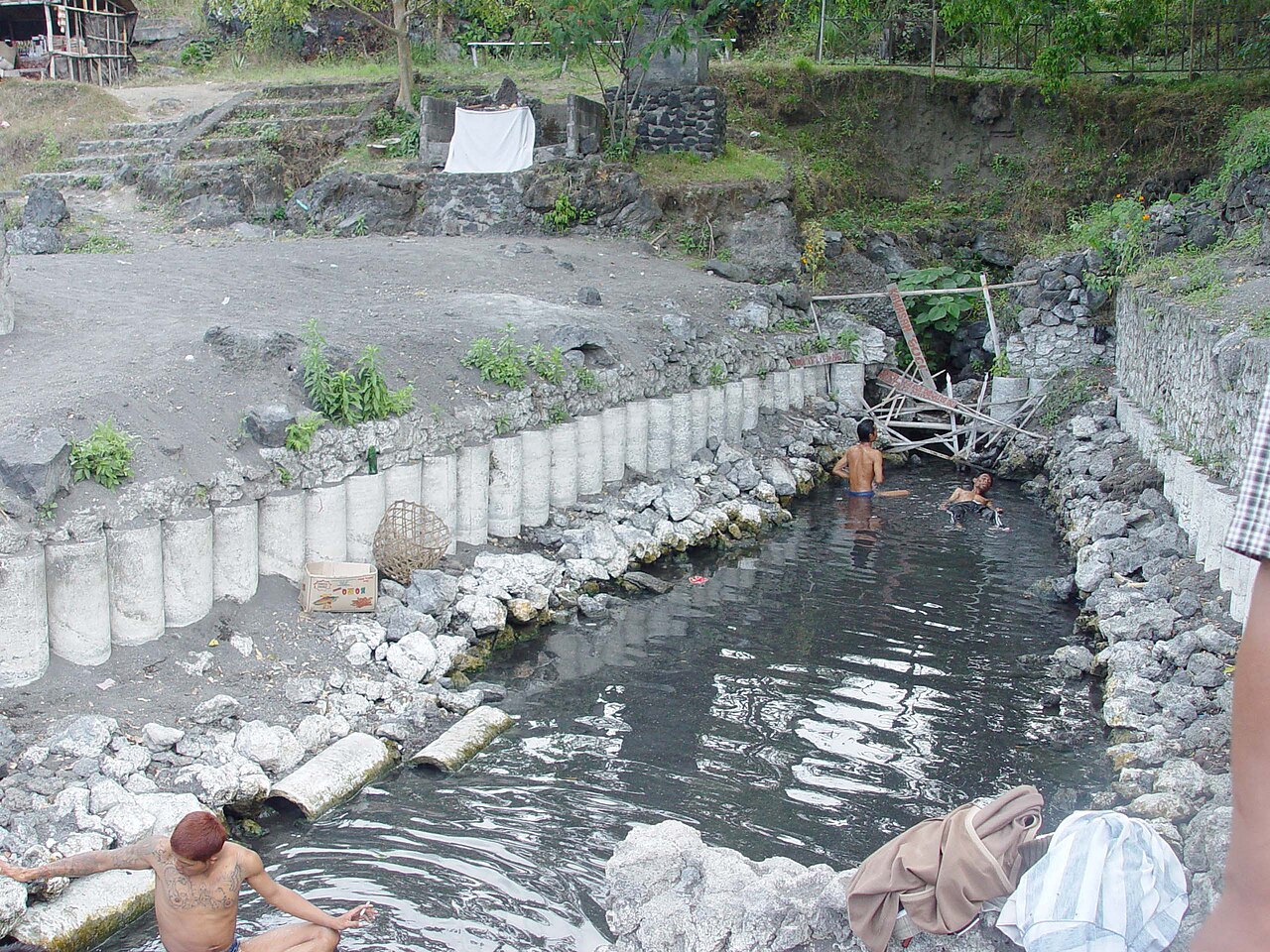
Photo: Unknown author — CC BY-SA 3.0, via source

At the base of Mount Batur, on the lake shore. Thermal mineral water rises from an aquifer 637 metres down, feeding pools between 37 and 43°C.
It is the obvious thing to do after a pre-dawn Batur trek, and it works exactly as you'd hope on the legs. The water is credited locally with easing muscle tension and speeding recovery, and the springs carry a reputation as a sacred healing site.
Air Sanih — Buleleng

Illustration: Miragi
On the north coast, a spring-fed bathing spot that's been a destination since 1930. Two natural pools — the adult one up to 1.5 metres deep, plus a shallow children's pool — filled by an underground spring that runs year-round.
Its oddity is the location: metres from the sea, and the water is completely fresh. Local belief holds that it arrives via an underground river from Lake Batur, which is a long way south. A temple to Vishnu stands beside it, and the water is regarded as spiritually cleansing.
Why the temples are on the shore
Every lake here has a temple, and that is a system rather than a coincidence. Subak, Bali's UNESCO-recognised irrigation institution, allocates water through councils of farmers whose decisions are ratified at water temples — with the lake temples at the top of the hierarchy. Managing the water and worshipping the goddess of the water are the same activity.
Miragi's narrated audio guides cover each of these sites, including the Kebo Iwa legend and how the subak hierarchy actually works. Over 200 sites across Bali.
Bedugul and Kintamani are both cool and often wet — the weather guide is worth checking before you plan a lake day.